
News & Insights
In the News
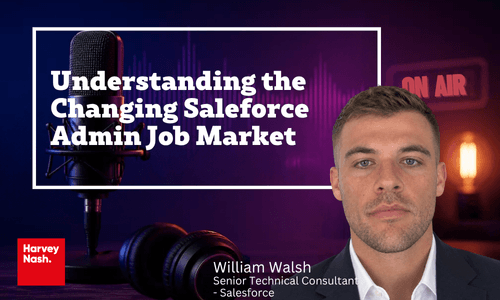
Understanding the Changing Salesforce Admin Job Market
Salesforce recently invited Harvey Nash’s very own William Walsh, Senior Technical Consultant - Salesforce, to join the Salesforce Admins Podcast for a conversation about the current Salesforce Admin job market. Hosted by Mike Gerholdt, the episode also features Maria Alvarez-Zarrilli, Founder and Principal Consultant at Throughline HR LLC. Together, they explore how the Salesforce Admin role is evolving and what today’s changing market means for professionals looking to build or grow their careers in the Salesforce ecosystem. The conversation looks at some of the questions currently shaping the Salesforce talent market, including what employers are looking for, how candidates can stand out, and how expectations around Salesforce roles are changing. William brings his perspective from working closely with both organizations and Salesforce professionals, while Maria adds her experience from the HR and career development side. The discussion touches on experience, skills, AI, communication, career paths, and what it takes to keep learning in a fast-changing technology landscape, but there’s much more to the conversation than we can cover here. Listen to the full Salesforce Admins Podcast episode to hear William and Maria’s perspectives firsthand and get a closer look at what’s happening across the Salesforce Admin job market. Whether you’re a Salesforce professional thinking about your next career move or an organization looking to understand the talent landscape, it’s a conversation worth tuning into.
In the News

AI and jobs: People will be at the heart of making AI work
This article was originally published on ComputerWeekly.com and is authored by Jason Pyle, Managing Director, Harvey Nash USA & Canada AI may be eliminating some job roles, but overall demand for human labour will increase amid signs of an 'AI boomerang'. It’s a subject that attracts endless debate: will AI replace whole swathes of human jobs and create an exodus from white collar professions? The trigger for me writing some reflections on this question is that no other than Jeff Bezos weighed in on the topic recently when speaking at a conference in Paris. His view was that far from decimating human roles, AI would unlock new opportunities and increase demand for human labour. I am in the Jeff Bezos camp. My belief is that just as other defining shifts like the creation of the internet created whole new classes of employment, so too will AI. That is not to say that it won’t redesign or remove some roles as the technology takes over certain tasks and processes itself – but it will also spawn new human activities. As an example of how things are changing, take software development. Increasingly, and as is already happening, AI will write new code itself. But skilled human engineers are still needed to manage the process, and oversee and check the results. Crucially, their human skills and experience will continue to be essential in making sure that the products being developed meet the needs of customers and support the strategic priorities of the business. That human understanding of the wider picture is something that AI may never be able to replace. An ‘AI boomerang’? As in any transformation, there will be something of a rebalancing. Interestingly, we are already seeing signs of this in the market – back in the favour of human skills. Talk is growing of an ‘AI boomerang’ amongst some organisations who cut back on existing staff or new hiring due to AI, but who are now beginning to push the balance back. There are several reasons for this. One is that it is still very early days in the AI revolution and organisations are still trying to find the appropriate model to set themselves up for it correctly. Another is that many businesses are still struggling to achieve real ROI from their AI investments – partly because it is early days – as our own research at Harvey Nash has shown: the 2025 Digital Leadership Report (DLR) found that only a third of businesses have achieved demonstrable ROI. A third element, related to this, is that AI is proving expensive. The newer AI models consume large numbers of tokens – the ‘burn’ is significant. These factors are all contributing to that boomerang effect. More broadly, the US technology recruitment market is holding up, with certain roles (AI engineers, data scientists, DevOps professionals, cybersecurity specialists) in high demand. AI will be additive There are other reasons to be optimistic from a human point of view. Our DLR also finds that the more an organisation invests in AI, the more likely they are to recruit technologists, rather than reduce the size of their workforce. In fact, we found that those organisations most ahead with large-scale implementations of AI are 24% more likely to be increasing their tech headcount than their peers, mostly in areas of AI and data. Other studies bear this out. For example, the Financial Times reported recently on research by Ramp across almost 22,000 companies in the US which found that firms making the largest AI investments grow employment by roughly 10% following adoption, while low-intensity adopters see no statistically significant change. Entry-level headcount rises 12% for high-intensity adopters too. This fuels my belief that AI will overall prove additive rather than taking away. It will create changes in how people work and what they do, but used effectively it will be an augmenter. The task in front of organisations is to get the balance right. It will be rather like seasoning a dish: you don’t want to go too heavily with any one ingredient but rather bring out the flavours from the right combination. Upskilling is crucial However, there is another element that is key to getting this right: upskilling. Whether it’s the tech team or other staff, it is critically important that people are empowered and enabled to use AI tools effectively, getting the most out of their capabilities and also managing the outputs appropriately. But this is an area where many businesses have more to do. The Harvey Nash Tech Talent & Salary Report found that while the majority of technologists (76%) have access to AI tools, far fewer feel they are being given structured support, time or clear frameworks to build capability (36%). Less than half (43%) are being given dedicated time to experiment and learn. A significant proportion report being expected to self‑learn (20%), while others are still waiting for formal training to be introduced (23%). I would urge organisations to step up their efforts in this area. Equipping people for AI is the real battleground in front of us. Investing in learning & development programmes, giving staff time to experiment and learn, and unlocking knowledge transfer via external parties the business works with, such as consultancies – all of these will contribute to the goal. It is worth exploring governmental support too. For example, in the US, the Department of Commerce’s Economic Development Administration (EDA) has launched a new initiative to put $25 million towards the AI Upskill Accelerator, a national grant competition to fund industry-led sectoral workforce partnerships that help upskill and reskill workers around AI technologies. Similarly, in the UK, the government is tackling the national AI skills gap through the AI Skills Boost, which aims to upskill 10 million workers by 2030. Led by DSIT and Skills England, the strategy combines free online training with major tech firms and reforms to technical education. Opportunity ahead The impact of AI on human jobs is still unfolding, and it will be a nuanced picture. However, I take a positive view. There seems little doubt that the organisations who harness AI effectively will be the winners of the future, launching value-adding new products and services, finding ways to do things smarter, boosting productivity. This brings enormous opportunity – and people will be at the heart of making it happen.
In the News
In-office culture rewards U.S. tech professionals
- U.S. tech workers the most likely to work four or even five days in the office - But Americans are the happiest tech professionals globally and the most likely to have received a promotion and pay rise of 10% of more - High levels of retention compared to global counterparts Although twice as many tech professionals in the U.S. are mandated to attend the office four/five days a week compared to any other country (34% vs 17%), a new global study finds that they are the happiest with their role amongst the countries surveyed, and are the most likely to have received a pay rise of 10% or more (38% vs 25%) and/or a promotion (24% vs 22%) in the last year. The ability to work from home appears to matter less to U.S. tech professionals than those in other countries, with only 38% considering it important compared to 52% globally, and only 34% saying they wouldn’t consider a role that didn’t have some degree of remote working compared to the global figure of 50%. The Harvey Nash Tech Talent & Salary Report, that surveyed over 3,600 technology professionals globally (629 in the U.S.), also found that high levels of promotion and financial reward in the U.S. tech industry are driving improved retention levels, as U.S. tech professionals are more likely to have been in role 3-5 years than those in any other country (26% vs 20%). There are other favorable factors supporting job satisfaction across the U.S. tech sector: more U.S. professionals report that they have seen reduced workloads than in any other country (21% vs 13%) and they generally feel less under-resourced than their global counterparts. Tech professionals based in the U.S. also feel the most supported with both their physical (37% vs 34%) and mental wellbeing (40% vs 35%). Jason Pyle, Global COO & President of Harvey Nash USA & Canada said: “At a time when much of the conversation around the tech labor market has been pessimistic, our U.S. data tells a far more encouraging story. Many tech professionals are feeling valued, rewarded and supported at work – and that’s translating into higher levels of job satisfaction and retention. What stands out is that U.S. organizations are successfully linking investment in people with business outcomes. Competitive pay rises, promotions and a stronger focus on wellbeing are clearly resonating, even in more office‑based environments. For employers, this reinforces an important point: engagement and reward still matter more than any single policy on where work gets done. However, this shouldn’t lead to complacency. The most sought‑after, niche skills remain highly mobile, and expectations continue to rise. Organizations that want to attract and retain specialist tech talent need to continue to evolve their employee proposition to compete.” Across the 629 U.S technologists surveyed, The Harvey Nash Tech Talent Report also found the following: Push and pulls factors for technologists: - Push factors - For over three quarters (43%) of technologists in the U.S., pay retains its top position as the primary reason for considering leaving their role, with the culture of their organization second (35%) and career progression not far behind (33%). - The most important pull factors for men and women - Female technologists in the U.S. are slightly more concerned with factors such as paid time off, flexible working hours and retirement benefits than their male peers. In turn, men are more interested in opportunities for career progression and the nature of the projects. Reskilling and upskilling in AI: - AI is taking my job – More U.S. respondents than in any other country feel that their role is under threat from AI (49% vs 43%). - Experimenting in AI – Almost two thirds (64%) report being given access to AI tools and platforms, and 34% are given dedicated time to experiment and learn. - Waiting for training or left to self-learn – U.S. organizations are the least likely to provide employees with internal training programs (51% vs 69% globally), and a quarter of technologists (24%) are expected to either self-learn or are waiting on formal training. Good tech leadership: - Great leaders - When it comes to defining what makes a great tech leader, more than half (54%) of respondents say that great communication remains key, and 43% value their leader’s ability to create a positive culture within the team. - Deep understanding of tech – Technologists in the U.S. also continue to value their leaders having a deep understanding of technology, with almost half (46%) making this one of their top three leadership traits. 1 in 8 feel that a lack of technology understanding amongst leaders is a huge barrier to delivering their tech goals, with a quarter (25%) rating it as a significant issue. IT Strategy also appeared on the top list of leadership qualities for the first time in several years of reporting – a sign that technologists may be concerned about the need for clear strategic and business case direction in the age of AI. The Inclusive workplace: - Tech sector not doing enough - While just under a half (48%) think the tech sector is doing enough to support female participation in technology, almost one third of female respondents (30%) actively disagree, wanting to see more concrete action – much higher than amongst men where only a fifth (19%) feel this way. - Decrease in focus and investment in DEI – Although almost all (80%) think their organization does enough to support diversity as a whole in the workplace, around 2 in 10 technologists report a decrease in focus and investment in DEI over the last two years. - Sense of purpose vs. DEI - Almost all (87%) tech professionals in the U.S. stated that an organization’s sense of purpose is important when selecting a new role, but only 61% think their approach to DEI holds the same weight. This rises to 71% when the respondent identifies as any ethnicity other than white; 46% of white males agree. Simon Crichton, CEO of Harvey Nash concluded: “With technology moving so fast, and AI beginning to change the game, technology leaders have many plates to spin. Tech professionals are looking to their leaders with an expectation of clear strategic direction, fair reward and a supportive environment in which they can build fulfilling careers. A standout feature this year is tech team members’ concern that IT strategy should be clear. There are undercurrents of worry about the impact of AI – even if it also presents career opportunities. The best technology leaders are those that integrate the development and deployment of AI into a coherent overall strategy that continues to have the skills and abilities of tech professionals at its heart.” -ENDS- About the report The Harvey Nash Global Tech Talent & Salary Report is based on a survey of over 3,646 technology professionals globally (including 1,394 in the UK and 629 in the US). The survey took place between 4th November 2025 and 26th January 2026. This report is part of a suite of reports and surveys that Harvey Nash publish annually, including its highly respected Digital Leadership Report, which was launched in 1998 and is the world’s largest and longest running survey of senior technology leaders. To request a full copy of the results, please visit https://www.harveynashusa.com/research-whitepapers/tech-talent-and-salary-report-2026. About Harvey Nash Harvey Nash is a specialist global technology recruitment firm that connects the world's most innovative companies with the technology talent they need to succeed. For over 35 years, Harvey Nash has been a pioneer and leading voice in the global technology space, having long term strategic partnerships with blue chip customers. With offices across multiple continents, including North America, the UK. Europe and Asia, Harvey Nash experienced in partnering with organizations on their specialized technology talent requirements including Cyber, DevOps, AI & Automation, Data, Cloud and Software Engineering. For further information visit https://www.harveynashusa.com/ Media Contacts:Michelle Thomas Harvey Nash michelle.thomas@harveynash.com +44 (20) 7333 2677
In the News

Harvey Nash Named an Allegis Global Solutions 2026 Strategic Supplier Across North America and EMEA
Harvey Nash is proud to announce they have been named a 2026 Strategic Supplier by Allegis Global Solutions (AGS) across North America and EMEA, recognizing the company’s consistent performance in delivering high-quality technology and professional talent to global enterprise clients. The AGS Strategic Supplier designation is awarded to a select group of partners who demonstrate exceptional performance across key metrics including quality of hire, responsiveness to requisitions, successful placements, bill rate management compliance and overall partnership effectiveness. For Harvey Nash, the recognition reflects a long-standing commitment to operational excellence and trusted partnership within AGS workforce programs. In North America, this marks the 11th consecutive year Harvey Nash has been named a Strategic Supplier by Allegis Global Solutions. In EMEA, Harvey Nash has achieved this recognition for 7+ consecutive years, underscoring the company’s global strength in delivering specialized talent across key technology and digital roles. Being recognized as an Allegis Global Solutions Strategic Supplier for the 11th consecutive year in North America is a testament to the dedication and expertise of our teams,” said Keegan Banks, Senior Vice President of Client Delivery, Harvey Nash USA. “Our partnership is built on deep integration, specialized delivery, and a proactive approach to anticipating workforce needs. This enables us to deliver exceptional technology talent while helping clients stay ahead in an increasingly complex and rapidly transforming technology landscape.” In EMEA, Harvey Nash’s continued inclusion on the Strategic Supplier list highlights the company’s ability to support complex workforce programs across multiple markets and industries. Allegis Global Solutions evaluates suppliers through a comprehensive performance framework supported by its Acumen® Intelligent Workforce platform, alongside direct feedback from client program teams. “As the workforce landscape continues to evolve, our supplier network plays a critical role in helping us lead with agility and innovation,” said Allegis Global Solutions President Steve Schumacher. “Our 2026 Strategic Suppliers deliver specialized talent quickly, adapt to changing business needs and drive impactful results for our clients. We value their collaboration and look forward to continued success.”Harvey Nash’s continual highlighted in the Strategic Supplier program reinforces its reputation as a trusted global partner for organizations seeking highly skilled technology professionals. About Harvey Nash Harvey Nash, part of Nash Squared, is a global professional services and technology recruitment specialist. With decades of experience connecting organizations with highly skilled technology and digital talent, Harvey Nash partners with clients across industries to support transformation, innovation and growth.
In the News

5 Ways to Land a Leadership Role in the Age of AI Disruption
This article was originally published by ZDNET, and features insights from Jason Pyle COO at Harvey Nash. 5 ways to get a leadership role - even if AI is disrupting the career ladder AI has changed all the rules. To get to the top, you'll have to prove you're ready for responsibility. Here's how. Some managers reach a certain rung on the career ladder and get stuck. Research suggests there are many potential factors at play, including limited opportunities to progress into management as traditional career ladders crumble in an age of AI. Professionals who move into senior leadership positions must prove they're worthy of the responsibility. Here, business leaders share their tips for climbing the career ladder. 1. Take unusual opportunities Barry Panayi, group chief data officer at Howden, an insurance intermediary group, said one of the first steps for would-be executives is to make a name for themselves. "I think it's about making connections with people that you like and admire," he said. "For 10 or 15 years at the beginning of my career, I made sure I was at conferences listening to people." As he climbed into senior positions, Panayi told ZDNET, he looked for opportunities outside his comfort zone to prove his leadership credentials. One of Panayi's most crucial development opportunities was taking on non-executive positions -- with UK energy regulator Ofgem since 2020, and media company Reach since 2021. "Those positions really gave me perspective, because I was quite narrow," he said. "All I'd ever done was data. I felt like I wasn't rounded enough, and being around the board table, contributing as a board member, forced me to consider other things." Panayi advised other next-generation leaders to look for similar opportunities, whether that's a non-executive role, a trustee at a charity, or a governor at a school or college. "Experiencing something completely different from the day-to-day job is about understanding the business. I think that exposure is what gives me confidence to have opinions on topics outside of my lane," he said. "It's those kinds of opinions and contributions that get you noticed, not being a great data person, because people will assume you're good at that area. After all, that's why the board hired you." 2. Show your commitment Jason Pyle, COO at recruitment specialist Harvey Nash, said that making the breakthrough from manager to senior executive means demonstrating you think strategically rather than just operationally. "Show that you understand the organization's wider strategy and how your role and the team you lead fit within that approach," he said. "It's also about thinking commercially -- being able to demonstrate that you understand how the operational decisions you make, in whatever aspect you're leading, impact top and bottom-line business value. Think like a business shareholder, not just a manager of your team." Pyle told ZDNET that senior professionals must be willing and able to smash the glass ceiling. "An executive can't just sit in their box and work in a silo. They must understand what's going on across the business and how it all links up. So, build connections and collaborate where possible with others outside your direct area of control," he said. "You need to show tact and political acumen. Don't overstep the mark. Take the initiative by putting your hand up for projects and special pieces of work that need to be managed. Show willingness and commitment, although be careful not to overload yourself." 3. Stay humble Joe Depa, global chief innovation officer at consultant EY, said successful leaders stay open to the opinions of a broad range of stakeholders and partners. "That humility right now is going to be critical," he said. "When I look at successful leaders that I tend to model myself after, I think the key to success is not only having the ability to learn but also having the mindset that you don't know all the answers." Depa told ZDNET that ignoring others' opinions is a potential shortcut to disaster. "When I've seen some people fail, or they're not executing on their task, it's because they weren't open. They didn't consider this concept that I call an open innovation ecosystem," he said. "They weren't listening to the pulse of the business, they weren't listening to their customers or users, and they weren't listening to their partners." Rather than staying open, these executives stayed closed and overlooked guidance that could have had a positive influence: "They had a strategy that they wanted to implement, and, therefore, they were ignoring stakeholders that would be either impacted or could help advise on that strategy." 4. Support the next generation Dawn McCarroll, director of supply chain and business excellence at telecoms specialist Helios Towers, said that integrity is key to proving you're ready for responsibility. "You need to know that trust is essential to move anything of significance forward," she said. "A lot of people talk about emotional intelligence, but I think you need a balance of emotional and perceptual intelligence." McCarroll told ZDNET that perceptual intelligence is not just about how people perceive you, but how you perceive others and how you maintain conversations with them. She also said people moving into management positions must start thinking about how they'll give similar opportunities to others. "Paying it forward is really important for the next generation," she said. "And as a leader, if you're not creating the next generation and the generation after that, what are you doing?" McCarroll said Helios Towers has a strong culture of promoting and developing talent from within, including certifying people in Lean Six Sigma through a leadership program with Cranfield University, partnering closely with the internal HR department, and developing regular succession planning opportunities. "I see myself as here to create a legacy of future leaders," she said. "You get to a point in your career where that then becomes your raison d'etre. It's no longer just about you climbing a career path. It's about what you're leaving behind." 5. Demonstrate your hands-off style Harvey Nash's Pyle also stressed that would-be senior executives must emphasize their interest in next-generation talent. "Show that you've got what it takes to be a leader in the way that you manage and develop your team," he said. "Make sure you give team members the support and guidance they need. Be there for them, while setting clear stretch goals." Pyle told ZDNET that managers who can demonstrate their hands-off credentials will show they're able to move into a senior role. "Through the performance of your team, show that you're able to scale what you've already got," he said. "Try to get your team to the point where it can virtually run itself. If executives are worried that elevating you will create a problem because your team can't operate without you, that could be a blocker to your promotion." Written by Mark Samuels, Senior Contributor, ZDNET.
In the News

AI’s challenge for entry level roles: all change?
This article was originally published on Computing.com and includes insights from Bev White, Executive Chair, and Andrew Neal, Chief People Officer, at Nash Squared. ‘AI is killing junior jobs’ misses important nuance – but you still need a strategy AI is challenging conventional models as organizations strive to integrate it for a range of operational and performance gains. The impact of AI on human roles is an area of particularly live debate – especially at entry level. With AI’s ability to handle many repeatable, admin-based tasks, will it lead to the removal of whole swathes of beginner roles that are the traditional entry point for young talent into a wide range of careers? There is no doubt that AI is already having some impact. Big Tech firms have pointed to AI when strumming back areas of their workforce; professional services firms are reducing their entry level intakes in some instances; in technology, there have been reports of demand for junior coders softening due to AI as the job transitions more to an oversight role. However, the situation is actually nuanced as there are multiple factors at play in these changes, including economic cycles and market conditions: it is by no means only about AI. For instance, management consulting revenues (a large part of the professional services sector) contracted in the UK in 2024 and only experienced very modest growth in the past 12 months after a post-pandemic boom. Large professional services firms, such as the Big Four, are naturally going to react to these market conditions by offering fewer graduate/entry level roles. Nevertheless, it is clear that as AI continues to rapidly develop and becomes integrated more widely into businesses’ systems and processes, the impact on human roles will increase – and this may be most pronounced at entry level, where much of what people do is ripe for automation. In this, we can include our own industry of recruitment. Consultants at the start of their career journeys traditionally spend a lot of their time on manual tasks such as sourcing roles that need to be filled, researching market information, compiling lists of potential candidates and sifting through/shortlisting applications. The requirement for people to do this will fall as AI solutions are developed. Shifting the focus to skills The crucial point is that AI will change what businesses look to people to do – not remove the need for them. We will still need entry level talent in recruitment, just as they will be needed in technology, professional services and other industries, even if there may be some +/- movement around the edges. But the emphasis will shift – from a focus on learning tasks and processes to developing the human skills and attributes that make great professionals and leaders: commerciality, critical thinking, ethical and moral considerations, stakeholder engagement, and communication. At the same time, individuals’ ability to understand and interpret what AI is telling them will be key. Businesses will start looking for talent that can accelerate faster into these human skills – the baseline will move up, given that most Gen Zers are already quite proficient in using AI platforms like ChatGPT and Copilot. From this, it follows that AI will open up opportunities for the best talent to move into more senior and remunerative roles faster. With AI tools supporting them, bright and capable professionals may be able to perform a role that currently typically requires three years of experience after only one year, for example. Filling the experience gap However, there is an ‘elephant in the room’. We all know – thinking back to our own personal experiences – that learning on the job in the early days, painstakingly building up the know-how, making mistakes and reflecting on them, seeking counsel and guidance from others, is a key part of how anyone becomes proficient in their field. It is the lived and learned experience that makes great professionals and leaders. The question arises, therefore, of how young talent will develop that essential on-the-job knowledge if AI is helping them to leapfrog forward. This is something that has also become more complicated due to the rise of hybrid working, which has reduced the facetime with colleagues and line managers that is a critical part of the learning and teaching curve for young joiners. This is an issue that businesses need to be really alive to right now, thinking ahead to prevent a capability vacuum, including at a leadership level, in the years to come. One of the key ways to tackle it is sure to lie in training and development. There will need to be a shift in training for young talent, moving the focus from tasks and processes to experiences and skills. Technology itself can play a huge role here, with the potential to create situation-based simulated experiences for trainees that take them through a ‘live’ scenario with AI playing the role of a client or other stakeholder, helping them develop that learned experience. A parallel here is rookie Formula One drivers, who spend a lot of time in a simulator – a safe space to learn, push themselves and crash if necessary. The notion of metaverse-style virtual reality training may seem extreme, but it’s something that we can expect more and more organizations to start exploring. Companies won’t have to go to those lengths, but it’s a certainty that any organization that wants to thrive in the future will need to devise training and development mechanisms that help entry level talent build up their skills-based muscle and baseline expertise - rather than simply teach them how to do process X or Y. Taking ownership in the boardroom The implications of this are far-reaching, and it should be a priority issue for boards around the world. There needs to be discussion and clarity in the boardroom over what roles the business needs people to perform including at entry level; what skills and attributes are needed to execute them; how AI supports and facilitates in this; and then how the business is hiring, assessing and developing current and future talent. Once the strategy has been formed, it is critical that each part of the business executes it in relation to its own area. Every industrial revolution redesigns the workforce, and the AI revolution is no different. Put these issues on your executive agenda if they’re not there already. Doing nothing is not an option. Change is all around us, and the most successful organizations will be those who take early action to anticipate and respond now.
In the News
Harvey Nash Wins Clearlyrated's 2026 Best of Staffing Client Award for Service Excellence
Award winning firms have a Net Promoter®️ Score that is 80% higher than the industry average. WAYNE, NEW JERSEY – FEBRUARY 3, 2026– Harvey Nash, a leading staffing agency, announced today that they have won the Best of Staffing Client Award for providing superior service to their clients. ClearlyRated's Best of Staffing® Award winners have proven to be industry leaders in service quality based entirely on ratings provided by their clients. On average, clients of winning agencies are more than 50% more likely to be completely satisfied with the services provided compared to those working with non-winning agencies. Harvey Nash received satisfaction scores of 9 or 10 out of 10 from 66.7% of their clients, significantly higher than the industry’s average of 45%. “Being recognized as a Best of Staffing Client Award winner for the fourth consecutive year is an achievement we’re incredibly proud of. Our clients place deep trust in Harvey Nash, and this recognition reflects the strength of those partnerships and the dedication of our teams who deliver exceptional service every day. In a market where expectations continue to rise, we remain committed to pushing beyond traditional staffing to serve as true strategic talent partners and creating meaningful business impact for the organizations we support. We’re grateful for this recognition and energized to continue raising the bar in the year ahead.” said Jason Pyle, Global COO, President, Harvey Nash USA & Canada "It’s an honor to introduce the 2026 Best of Staffing award winners," said Baker Nanduru, CEO of ClearlyRated. "These companies keep client experience front and center, pushing the envelope in innovative service approaches. Their work is shaping the future of accounting, and it's a privilege to recognize their achievements. Congratulations to all!" About Harvey Nash Harvey Nash is a part of Nash Squared, the leading global provider of talent and technology solutions. Our network spans 2,800 colleagues across 16 countries and provides a uniquely broad range of service capabilities, from recruitment and workforce management to software development and technology solutions. We bring these together to address the unique challenges of our clients both now and in the future. Harvey Nash works with clients, both big and small, to deliver a portfolio of services: IT recruitment, IT outsourcing/offshoring, direct sourcing, contingent workforce solutions and executive search. About ClearlyRated ClearlyRated helps B2B service firms gain actionable insights to stop client issues from becoming lost revenue, expand their business with existing clients, and attract new ones. Learn more at https://www.clearlyrated.com/solutions/. About Best of Staffing® ClearlyRated's Best of Staffing® Award is the only award in the U.S. and Canada that recognizes staffing agencies that have proven superior service quality based entirely on ratings provided by their clients, placed talent, and internal employees. Award winners are showcased by city and area of expertise on ClearlyRated.com—an online business directory that helps buyers of professional services find service leaders and vet prospective firms with the help of validated client ratings and testimonials. ### Contact Brenna BarnettSenior Marketing Managerbrenna.barnett@harveynash.com
In the News

Harvey Nash Appoints Simon Crichton as CEO to Drive Next Phase of Growth
Technology recruitment specialist strengthens leadership team with proven industry executive as company advances growth strategy. LONDON, September 30, 2025 – Harvey Nash, a leading global specialist technology recruitment firm, today announced the appointment of Simon Crichton as Chief Executive Officer. The appointment supports Nash Squared’s strategic evolution following the successful divestiture of its NashTech business and positions Harvey Nash for accelerated growth in the technology talent market. Crichton brings extensive experience in the recruitment and technology services sector, most recently serving as Managing Director of Experis UK, the specialist technology recruitment division of Manpower. Prior to that, he led Akkodis UK as CEO, where he successfully managed the complex merger of the Akka and Modis brands on behalf of Adecco Group. “Simon’s appointment represents a natural evolution in our leadership structure as we enter an exciting new phase of growth,” said Bev White, who will transition from CEO to Executive Chair of Nash Squared, overseeing both Harvey Nash and Crimson businesses. “His proven track record of driving operational excellence in our sector makes him the ideal leader to execute on our strategic growth ambitions.” As CEO, Crichton will oversee day-to-day operations across Harvey Nash’s global markets, leading the continued execution of the company’s strategy, which emphasizes specialization, client growth, and operational excellence to address the critical technology talent needs of clients globally. The leadership transition is supported by recent key appointments including Rudolph Botha as Chief Financial Officer and Jason Pyle as Chief Operating Officer. “I’m excited to join Harvey Nash at this pivotal moment in the company’s development,” said Crichton. “Our strategy provides a clear roadmap for building a more focused and future-ready organization, and I look forward to working with the talented team to deliver exceptional value to our clients and create new opportunities for our people.” About Harvey Nash Harvey Nash is a specialist global technology recruitment firm that connects the world’s most innovative companies with the technology talent they need to succeed. Over the past 30 years, Harvey Nash has been a pioneer and leading voice in the global technology space, having long-term strategic partnerships with blue chip customers. With offices across multiple continents, including North America, the United Kingdom, and Germany, Harvey Nash specializes in contract recruitment for specialized technology talent requirements including Cyber, AI, and Data. www.harveynash.com About Nash Squared Nash Squared is the holding company for the Harvey Nash and Crimson brands. Media & Investor Contact: Rachel Watts, Global Marketing Director, Email: rachel.watts@harveynash.com
In the News
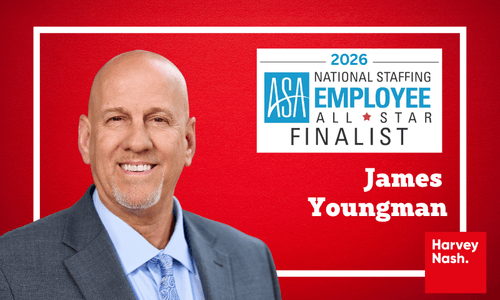
HARVEY NASH’s James Youngman Named a Winner for The 2026 National Staffing Employee of the Year Awards
HARVEY NASH’s James Youngman Named a Winner for The 2026 National Staffing Employee of the Year Awards American Staffing Association Honor Highlights Top U.S. Staffing Employees Alexandria, VA, September 2, 2025—Harvey Nash’s James Youngman, a Supplier Performance Engineer from Illinois, has earned national recognition from the American Staffing Association as a top staffing employee, Harvey Nash announced today. The National Staffing Employee of the Year program recognizes the most outstanding temporary and contract workers in the country. In 2023, U.S. staffing companies employed 2.2 million temporary and contract workers; James Youngman is one of just nine finalists to be recognized in the country. We are thrilled to hear James Youngman has been named 2026 American Staffing Association Employee of the Year Winner for the Engineering, Information Technology, and Scientific Sector. James is a contractor for Harvey Nash and we are proud of his accomplishments. More about his journey to Harvey Nash and career path. After more than twenty years as a schoolteacher and coach, James Youngman was ready for a new chapter. […] Through Harvey Nash, Youngman got his foot in the door at Caterpillar and gained the skills needed to become a Supplier Performance Engineer. He’s excelled in the role, working RCCA (Root Cause Corrective Action), as well as helping to develop new processes that could save the client company millions annually. Youngman’s story shows how partnering with a staffing firm delivers career-changing opportunities for workers and measurable returns on investment for client organizations. “I’m deeply honored and incredibly grateful to receive the ASA National Agency Employee of the Year Award. To be recognized by such a respected organization, among so many dedicated professionals across the country, is truly humbling. This award is a reflection of the amazing people I’ve had the privilege to work alongside; teammates, mentors, and clients, who inspire me every day. I want to express my deepest gratitude to Harvey Nash, the agency that believed in me and placed me in my full-time role with Caterpillar. A special thank you to Morgan Morris and Rachel Hutto for their unwavering support throughout my journey at Caterpillar, your guidance has meant the world to me. Thank you, ASA, for this extraordinary honor. ” said James Youngman when asked about winning this honor. As a National Staffing Employee of the Year Finalist, James Youngman and Harvey Nash will be recognized at the 2025 Staffing World convention and expo, held in Oct. 6-8, in Orlando, FL. # # # About the American Staffing Association The American Staffing Association is the voice of the U.S. staffing, recruiting, and workforce solutions industry. ASA and its state affiliates advance the interests of the industry across all sectors through advocacy, research, education, and the promotion of high standards of legal, ethical, and professional practices. For more information about ASA, visit americanstaffing.net. ContactBrenna Barnett Senior Marketing Manager Brenna.barnett@harveynash.com
Get in touch
If you're looking to secure your next role or make your next best hire, we'd love to help. Get in touch to speak with one of our consultants today